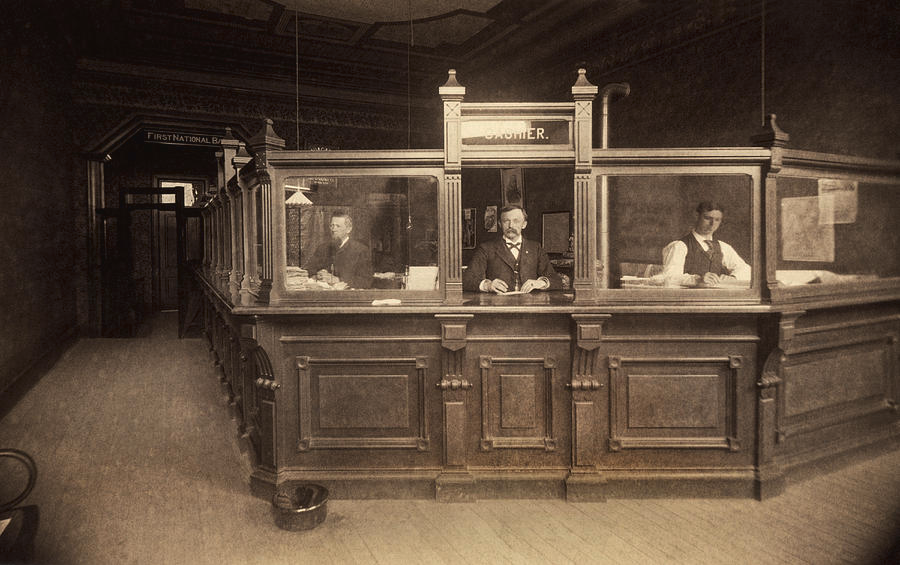
What happened to the 20th-century bank teller? They were once the knowledgeable experts in their field, handling a wide range of tasks that demanded proficiency in banking procedures and regulations. But as computerised systems, ATMs, and online banking entered the scene, the role of bank tellers began to shift, leading to the deskilling of the profession. The increased reliance on technology shifted the focus of their work towards less complex tasks, such as handling basic transactions and providing general customer support which require less expert knowledge.
The deprofesionalistion of this once highly respected career path gives a cautionary tale for educators as we navigate the integration of AI into our classrooms.
As teachers across the world are attempting to respond to the significant challenge generative AI brings to homework-based assessment, we have all seen students use ChatGPT in silly ways. These superficial approaches are nothing new. Copying large chunks of verbatim from Wikipedia the night before a looming deadline is a common technique for the unorganised young people among us. Now, their source of hope comes from ChatGPT. Unfortunately, despite the immeasurable power our students wield with this emergent technology, many are not even reading what is produced by the Large Language Model (LLM). Some just ignorantly paste what appears across their screen without any form of thinking.
Unfortunately, these students are not the only individuals in some classrooms doing silly things with ChatGPT. Many teachers across the globe are using about the same level of analysis when offering prompts to this digital personal assistant. Over the past few months, there have been countless examples of teachers inadvertently proclaiming on social media that ChatGPT can replace them in their profession. Various teachers have typed in the very simplistic prompt like, “plan me a lesson on…” and despite the often rudimentary lesson sequence they get back from the artificial intelligence, educators have quickly exclaimed that one of the core parts of our job can now be automated. While it is true that AI can certainly help teachers with the planning process, let’s slow down and use our professionalism and expertise in this process.
We do not want to mimic the simplistic behaviour of some of our students who naively use the first response they get back from ChatGPT.
Another concerning trend was epitomised for me recently on South Australia’s most widely used facebook group for teachers. An individual was gloating that all we need to do is feed the SACE performance standards into ChatGPT along with the assessment task. Then if we subsequently paste in student work, the LLM will quickly assess the work for us. Brilliant! Hours saved!
As professionals, we ought to know that something so complex as assessing human behaviour is not that simple. We need to go through a process of assessment validation before we trust this untested tool in assessing Year 11 and 12 writing. I would recommend anyone interested in this space to follow Daisy Christodoulou and her work at No More Marking. After rigorous testing, her team claims ChatGPT is currently not able to assess student work with reliable validity. This doesn’t mean it won’t ever be possible, especially as we move closer to some form of Artificial General Intelligence (AGI). However, it is very concerning that many individuals across our profession are so quick to blindly use ChatGPT to fruitlessly replace themselves in doing the core of our paid work, especially when AI cannot satisfactorily perform this specific task yet.
Educators ought to hear Sam Altman’s caution, the CEO of OpenAI, who is responsible for the technology behind ChatGPT:
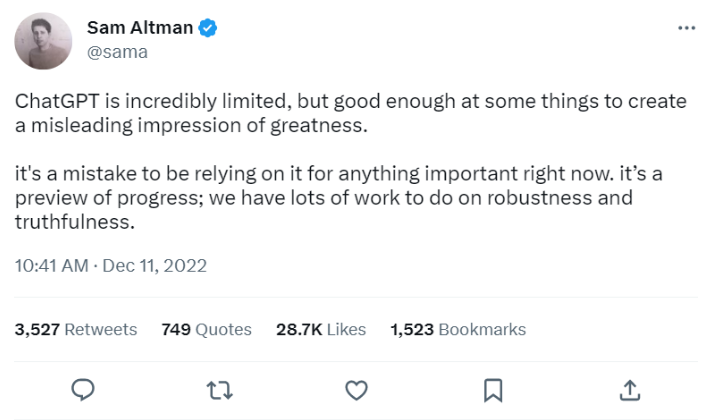
Let us not self-sabotage our own profession by checking out our expertise when using this emerging technology. Some of our key duties, such as planning, instruction and assessment are too important to be replaced so quickly by something “incredibly limited”.
I foresee two possible pathways emerging as we venture into this AI-infused era of education:
- A deprofessionalised teaching industry: In this scenario, human educators primarily serve as adult supervisors in the classroom, focusing on building positive relationships with students, while AI technologies assume full responsibility for curriculum and pedagogical expertise. Students engage with their 1:1 devices, receiving individualised instruction from AI teachers, while human “educators” ensure students stay on task. This is the future of many classrooms if we let the tech industry drive the narrative of AI in education. Have a look at Khanmigo, Khan Academy’s AI-powered tutor, soon to be heavily relied upon in many classrooms across the world. Our ancient craft is considered a modern day profession because of the expertise we bring to the classroom. Our knowledge about our subject areas, child development, curriculum design and assessment practices are the necessary expertise we cannot take for granted. Without the expertise in the above mentioned domains, what are we? Child minders? Experts at keeping eyes on screens? We cannot in the manner of a few months be so quick to hand over our core business: Planning, instructing and assessing our students. Obviously with positive relationships, these three tasks become measurably more impactful. However, if we ever so quickly submit control to AI, how can we continue to expect the public to view us as teaching professionals?
- Teacher Directed AI: Alternatively, we do not need to unnecessarily follow the same path as the 20th-century Bank Teller, significantly deskilling our profession by blindly handing over the reigns to half-baked AI solutions at the first chance we have. We could instead choose a pathway where we remain the experts in our field, retaining our knowledge in subject matter, child development, curriculum planning, and assessment. Moreover, we could show the world that we are in fact, professionals. Instead of uncritically using this technology as silly as some of our students. We could expand our expertise to include AI-enabled pedagogies and assessments, empowering us to continue to leverage the human-centric nature of teaching and learning. In this scenario, teachers would direct how AI technologies are used in the classroom (rather than the tech industry), ensuring they serve as valuable tools to enhance our practice, rather than fundamentally replacing us at our core tasks. With this comprehensive and expanding skill set, we can continue to justify our higher than average professional salaries and remain in demand from parents seeking a holistic, human-centered education for their children.
As educators in the AI era, we must adapt and develop our expertise, embracing tools like ChatGPT to enhance our practice while preserving the human-centric nature of teaching. The choice is ours: let’s shape a future that continues to elevate our profession, ensuring we remain irreplaceable despite the pace of technological change.
 Adrian Cotterell
Leave a comment